

Last updated: September 2026 – checked against current Motor Vehicles Act sign categories and the latest available government road-safety data.
Road signs are one of the simplest tools for preventing accidents, since a glance at a sign’s shape and colour can tell a driver what to do in a split second. Road accidents remain a serious problem in India: the Ministry of Road Transport and Highways reported over 1.8 lakh road deaths in a recent year, with road crashes costing the country an estimated 3% of GDP annually. Knowing traffic signs and rules well is one of the most effective ways any individual driver can reduce that risk.
This guide covers the three main categories of traffic signs used in India, examples of each, and the traffic rules every driver should know.
The Three Categories of Traffic Signs in India
Every official road sign in India falls into one of three categories, and recognising the category from a sign’s shape and colour is often enough to know how to respond, even before reading the text or symbol inside it.
1. Mandatory Signs

Mandatory signs are instructions you must obey. Most are circular with a red border. Ignoring one is a traffic offence and can result in a fine; see our traffic fines list for current penalty amounts.
| Sign | Meaning |
|---|---|
| Stop | Come to a complete stop |
| Give Way | Slow down and let other traffic pass first |
| No Entry | Vehicles are not allowed to enter |
| No Pedestrians | Pedestrians are not allowed here |
| Horn Prohibited | Sounding the horn is not allowed (silence zone) |
| No Parking | Vehicles may not be parked here |
| No Stopping or Standing | Vehicles may not stop or wait here at all |
| Speed Limit | Maximum speed allowed on this stretch of road |
| Compulsory Ahead / Left / Right | You must travel in the direction shown |
| One Way | Traffic may only travel in one direction |
2. Cautionary Signs

Cautionary signs are triangular with a red border and warn of a hazard ahead. On seeing one, slow down and watch for the specific hazard shown. India uses around 40 standard cautionary signs; here are the ones most drivers encounter.
| Sign | Meaning |
|---|---|
| Right / Left Hand Curve | The road bends in the direction shown |
| Right / Left Hairpin Bend | A sharp, tight bend in the direction shown |
| Steep Ascent / Descent | A steep climb or drop ahead |
| Narrow Road / Bridge Ahead | The road or bridge ahead is narrower than usual |
| Slippery Road | The road surface may be slippery, especially in rain |
| Pedestrian Crossing | A marked crossing for pedestrians is ahead |
| School Ahead | A school is nearby; expect children crossing |
| Men at Work | Road construction or repair work is underway |
| Cattle Crossing | Animals may cross the road here |
| Falling Rocks | Rocks may fall onto the road ahead |
3. Informatory Signs
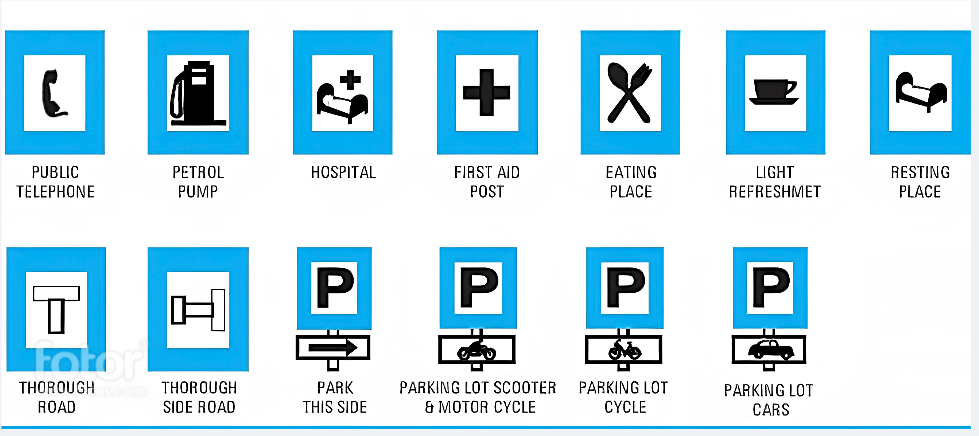
Informatory signs are usually blue rectangles that point drivers toward nearby facilities and give directions and distances.
| Sign | Meaning |
|---|---|
| Public Telephone | A telephone is available nearby |
| Petrol Pump | A fuel station is nearby |
| Hospital | A hospital is nearby |
| First Aid Post | A first-aid facility is nearby |
| Eating Place | A restaurant or dhaba is nearby |
| Resting Place | A rest area is nearby |
| Parking | Shows where you may park, sometimes by vehicle type (car, two-wheeler, cycle) |
For sign-recognition practice with marked correct answers, see our driving licence test symbols guide.
Other Ways Traffic Is Controlled
Besides fixed signs, Indian traffic is also controlled by:
Key Traffic Rules Every Driver Should Know
Why Traffic Signs and Rules Matter
Government data shows India recorded over 5 lakh road accidents in a recent year, with several hundred deaths every day nationwide. The Ministry of Road Transport and Highways continues to update rules and enforcement, including AI-based camera systems in several cities that automatically detect helmet, seatbelt and signal violations, so following the rules matters more than ever.
Frequently Asked Questions
How many types of traffic signs are there in India?
Three main types: mandatory, cautionary and informatory. Together with road markings and traffic police signals, they make up India’s traffic control system.
Which takes priority: a traffic sign or a police officer’s signal?
A traffic police officer’s hand signal or instruction takes priority over signs and signals when they are actively directing traffic.
Where can I learn more about individual signs for the licence test?
See our driving licence test symbols guide for shape and colour rules and practice questions, and our driving licence test questions and answers for general practice.
What happens if I don’t follow a traffic sign?
You can be fined under the Motor Vehicles Act, and repeated violations can lead to licence disqualification in several states. See our traffic fines list for current amounts.
Related guides: Vahan E-Services, Vahan Application Status, Different Types of Number Plates.