

Last updated: September 2026 – checked against the Motor Vehicles Act and current Vahan insurance records.
Every vehicle on Indian roads must carry valid motor insurance, and your policy details are now recorded against your registration number in the Vahan database. This guide explains the types of motor insurance in India, how to check a vehicle’s insurance status online, how to fix it when Vahan shows the wrong or outdated information, and what happens if you drive uninsured.
Types of Vehicle Insurance in India

Third-Party Insurance (Mandatory)
Third-party insurance is compulsory under the Motor Vehicles Act. It covers your legal liability for injury, death or property damage you cause to others, but it doesn’t pay for damage to your own vehicle. Premiums are set by the insurance regulator (IRDAI), not by individual insurers. New cars must be sold with a three-year third-party policy and new two-wheelers with a five-year policy.
Comprehensive Insurance
A comprehensive policy combines third-party cover with own-damage cover, protecting your vehicle against accidents, theft, fire, and natural disasters such as floods. It costs more than third-party cover alone, but it’s the only option that pays for repairs to your own vehicle.
Standalone Own-Damage Insurance
If you already have a long-term third-party policy (common for vehicles bought in the last few years), you can buy own-damage cover separately each year instead of a full comprehensive policy. This lets you shop around for own-damage cover without disturbing your existing third-party policy.
Compulsory Personal Accident Cover
Owner-drivers also need personal accident cover of ₹15 lakh, usually bought alongside the motor policy. You can skip it only if you already hold an equivalent personal accident policy.
How To Check Vehicle Insurance Status Online
Insurers now report policy details against the registration number, so you can check whether a vehicle is insured in a few ways.
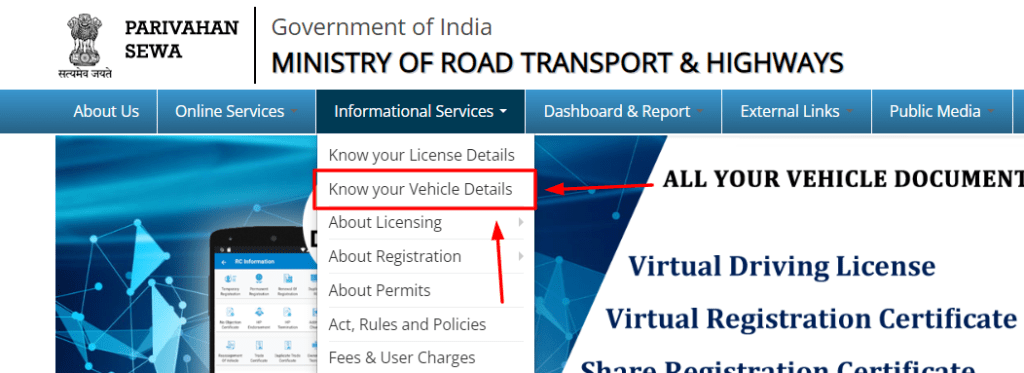
On the Vahan / Parivahan Portal
Other Ways To Check
How To Update Insurance Details on Vahan
You don’t normally update insurance on Vahan yourself. When you buy or renew a policy, the insurer uploads the details against your registration number, usually within a few days. If Vahan still shows an old expiry date or no insurance after renewal:
After an ownership transfer, the new owner must get the policy transferred into their name within 14 days. The previous owner’s no-claim bonus doesn’t move with the vehicle; it stays with the person.
Penalty for Driving Without Insurance
Driving without valid insurance can lead to a fine of ₹2,000 and/or up to three months’ imprisonment for a first offence, and ₹4,000 for a repeat offence. Beyond the fine, you’d be personally liable for any third-party injury or damage you cause, which can far exceed the cost of a policy. Since insurance status is now linked to Vahan, traffic cameras and e-challan systems in many cities can flag uninsured vehicles automatically. See our traffic fines list for other penalties.
Tips for Choosing and Renewing a Policy

For a closer look at keeping premiums down, see our guide to the cheapest car insurance in India.
Frequently Asked Questions
Is vehicle insurance mandatory in India?
Yes, third-party insurance is mandatory for every vehicle used on public roads. Comprehensive and own-damage cover are optional.
Why does Vahan show my insurance as expired when I’ve renewed it?
Either the insurer hasn’t uploaded it yet, or a detail on the policy doesn’t match your RC. Check the numbers, then contact your insurer to correct or re-push the record.
Is a digital insurance copy valid at a traffic check?
Yes, a policy shown through DigiLocker or mParivahan is accepted as valid.
How do I file a claim?
Inform your insurer as soon as possible after the incident, file an FIR for theft or third-party injury, and let the insurer’s surveyor inspect the vehicle before repairs begin.
Related guides: Vehicle Owner Details, Vahan PUC Certificate, Vahan E-Services.