

Last updated: September 2026 – checked against the Central Motor Vehicles Rules and the Vahan PUC service.
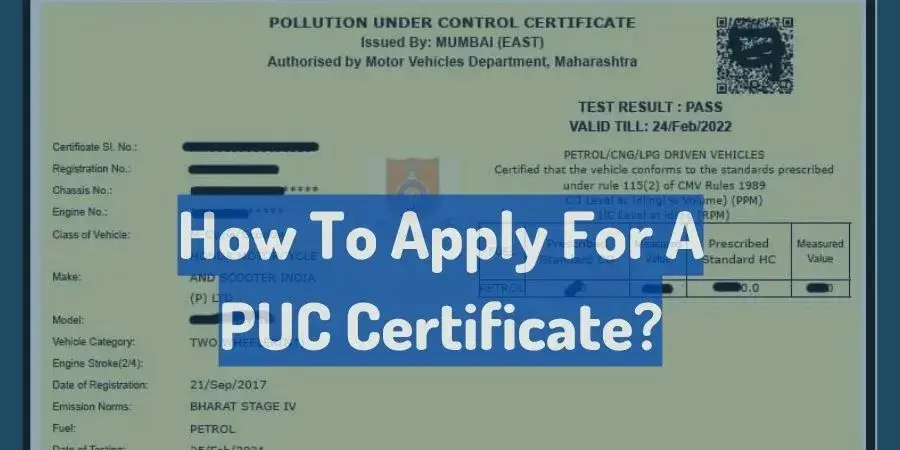
A Pollution Under Control (PUC) certificate confirms that your vehicle’s exhaust emissions are within the legal limits. Every petrol, diesel, CNG and LPG vehicle on Indian roads must carry a valid one. This guide explains how to get a PUC certificate, how long it lasts, how to check and download it online through Vahan, and what happens if you’re caught without one.
Who Needs a PUC Certificate
All motor vehicles with a combustion engine need a valid PUC certificate, including two-wheelers, cars, and commercial vehicles, whether they run on petrol, diesel, CNG or LPG. Battery electric vehicles don’t produce exhaust emissions and don’t need one. Brand-new vehicles come with a PUC certificate issued at the time of sale, so you only need to worry about it once that first one expires.
How Long Is a PUC Certificate Valid?
How To Get a PUC Certificate
There’s no online application that replaces the emission test itself: the vehicle has to be physically checked at an authorised PUC centre.
Because genuine certificates are issued through the national system, a certificate that doesn’t show up against your vehicle on Vahan may not be valid. Avoid any centre that offers a certificate without testing the vehicle.
How the Emission Test Works
The test differs by fuel type. For petrol, CNG and LPG vehicles, the analyser measures carbon monoxide (CO) and unburnt hydrocarbons (HC) in the exhaust while the engine idles, and for newer vehicles it also checks the air-fuel ratio at a higher engine speed. For diesel vehicles, the operator revs the engine sharply several times while a smoke meter measures how opaque the exhaust is. The limits are stricter for newer emission norms, so a BS-VI vehicle is held to tighter standards than an older BS-III or BS-IV one. The readings are printed on the certificate, which gives you a useful early warning: if your figures creep closer to the limit with each test, it’s a sign the engine needs attention before it actually fails.
How To Check and Download Your PUC Certificate Online
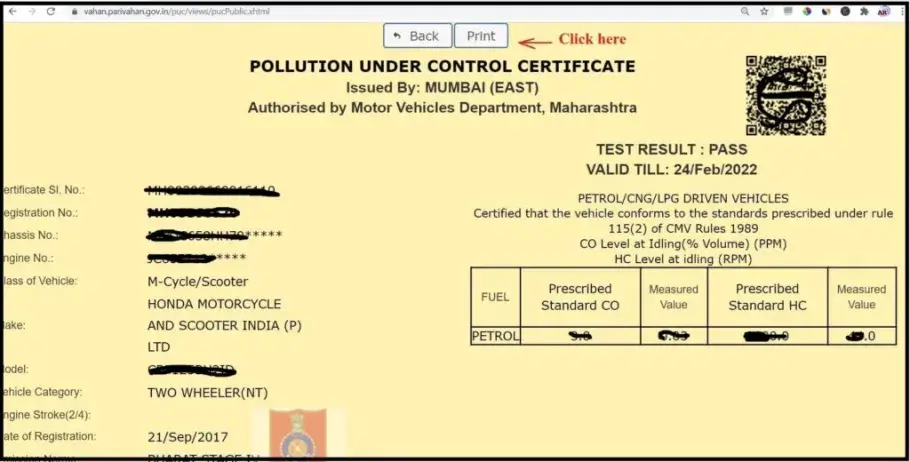
PUC validity also appears in the Know Your Vehicle Details results and in the mParivahan app, and a certificate shown through mParivahan or DigiLocker is accepted at a traffic check.
If Your Vehicle Fails the Test
If the readings exceed the limits, the centre issues a rejection slip instead of a certificate. Get the vehicle serviced (common causes are a dirty air filter, worn spark plugs, a faulty oxygen sensor or a clogged catalytic converter) and return for a retest. Getting a service done shortly before the test, and fixing a lit check-engine warning, makes a failure much less likely.
Penalty for Driving Without a Valid PUC
Under the Motor Vehicles Act, driving without a valid PUC certificate can attract a fine of up to ₹10,000 and/or imprisonment of up to six months, and your driving licence may be suspended for up to three months. Because PUC validity is now linked to Vahan, traffic cameras and e-challan systems in many cities can detect an expired certificate automatically. An expired PUC can also hold up services such as RC renewal and ownership transfer. See our traffic fines list for other penalties.
Tips To Stay Compliant
Frequently Asked Questions
Can I get a PUC certificate online without testing my vehicle?
No. The vehicle must be tested at an authorised centre. You can only check, download or reprint an existing certificate online.
What documents do I need at the PUC centre?
Usually none beyond the vehicle itself and its registration number. Keeping your RC handy helps if the operator needs to confirm details.
Do electric vehicles need a PUC certificate?
No. Battery electric vehicles have no exhaust emissions, so PUC doesn’t apply. Hybrids with a petrol or diesel engine do need one.
Is a PUC certificate from one state valid in another?
Yes. Certificates are issued through the national Vahan system and are valid across India.
What if I lose my PUC certificate?
You don’t need a new test. As long as the certificate is still within its validity period, download or print a fresh copy from the PUC Certificate section on Parivahan using your registration and chassis numbers.
Related guides: Vahan Insurance Details, Vehicle RC Status, Vahan E-Services.